

Best Exterior Coatings for Stucco, Wood, Metal & Concrete
When planning a commercial exterior painting project, choosing a color is only one part of the specification.
The surface underneath the paint matters just as much.
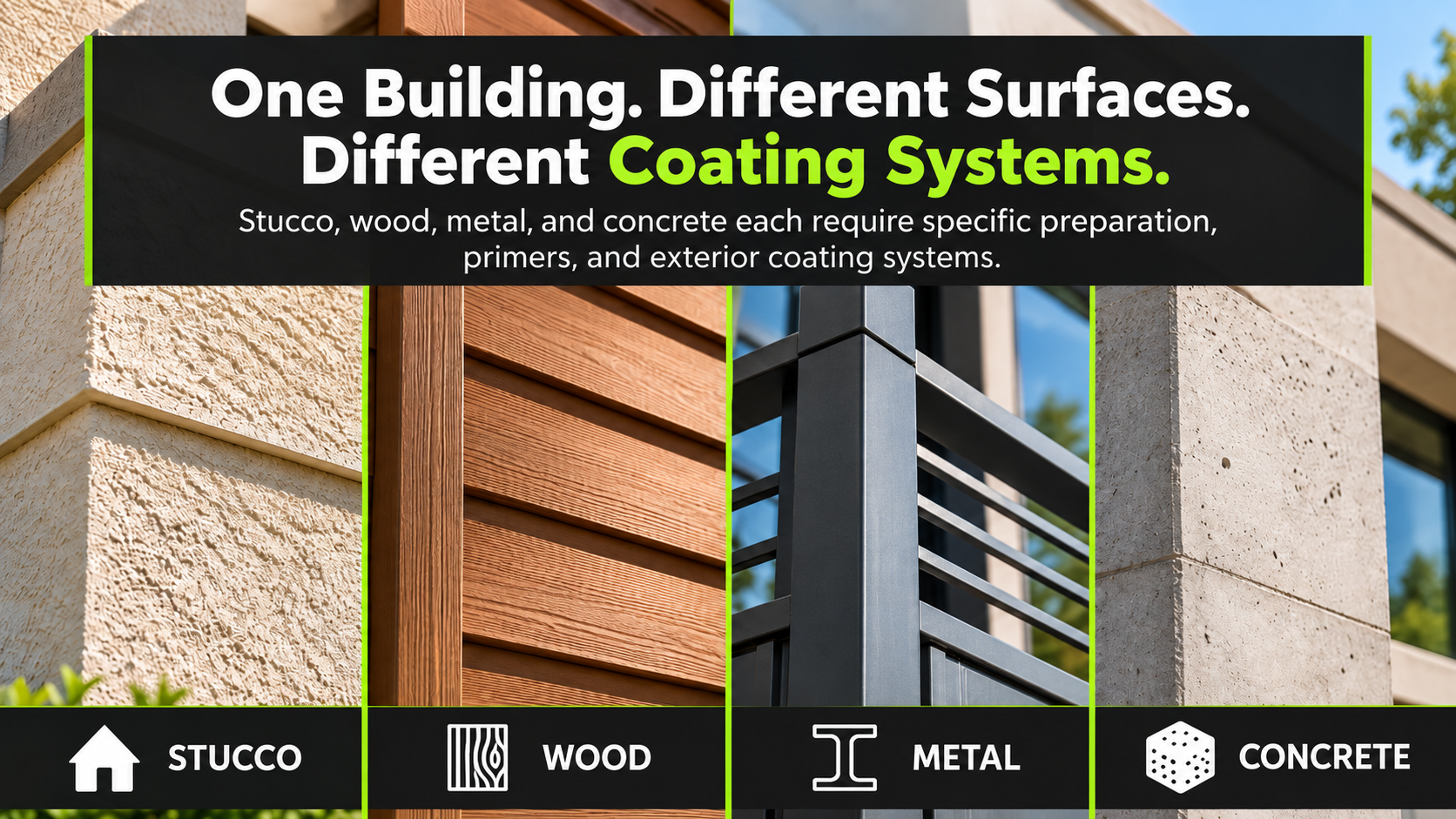
Stucco, wood, metal, and concrete each react differently to moisture, sunlight, temperature changes, and everyday exposure. They also require different preparation methods, primers, and coating systems.
That means there is no single exterior paint that is automatically the best choice for every part of a commercial building.
For property managers and facility managers, understanding these differences can help you evaluate proposals more effectively, ask better questions during walkthroughs, and make coating decisions that support the long-term maintenance of the property.
A professional commercial painting contractor should evaluate the substrate first—and specify the coating system second.
Why Exterior Coating Selection Starts With the Surface
Exterior coatings do more than improve a building's appearance.
Depending on the surface and environment, the coating system may also need to resist moisture, ultraviolet exposure, corrosion, expansion and contraction, staining, and general weathering.
But even a high-performance coating can struggle if it is applied over a surface that has not been properly evaluated and prepared.
Before recommending a coating system, a contractor should look at factors such as:
- The type and condition of the substrate
- Existing paint or coating
- Peeling, cracking, chalking, rust, or other deterioration
- Moisture conditions
- Previous repairs
- Surface contamination
- Adhesion of the existing coating
- Sun and weather exposure
- Building movement and expansion
- Desired appearance and sheen
- Expected maintenance cycle
For concrete in particular, industry guidance emphasizes evaluating existing coatings, contamination, defects, moisture, surface strength, and surface profile before selecting and applying a protective system.
The correct specification is therefore not simply:
“Apply two coats of exterior paint.”
It should answer three questions:
What surface are we coating?
What condition is that surface currently in?
What coating system is appropriate for that surface and exposure?
Here is how that process changes across four common commercial exterior substrates.
Stucco: Managing Porosity, Cracks, and Moisture
Stucco is one of the most common exterior surfaces on commercial and multifamily properties throughout California.
Although it may appear simple to repaint, stucco is a porous masonry surface. Its condition should be evaluated carefully before a new coating is applied.
What Should Be Evaluated?
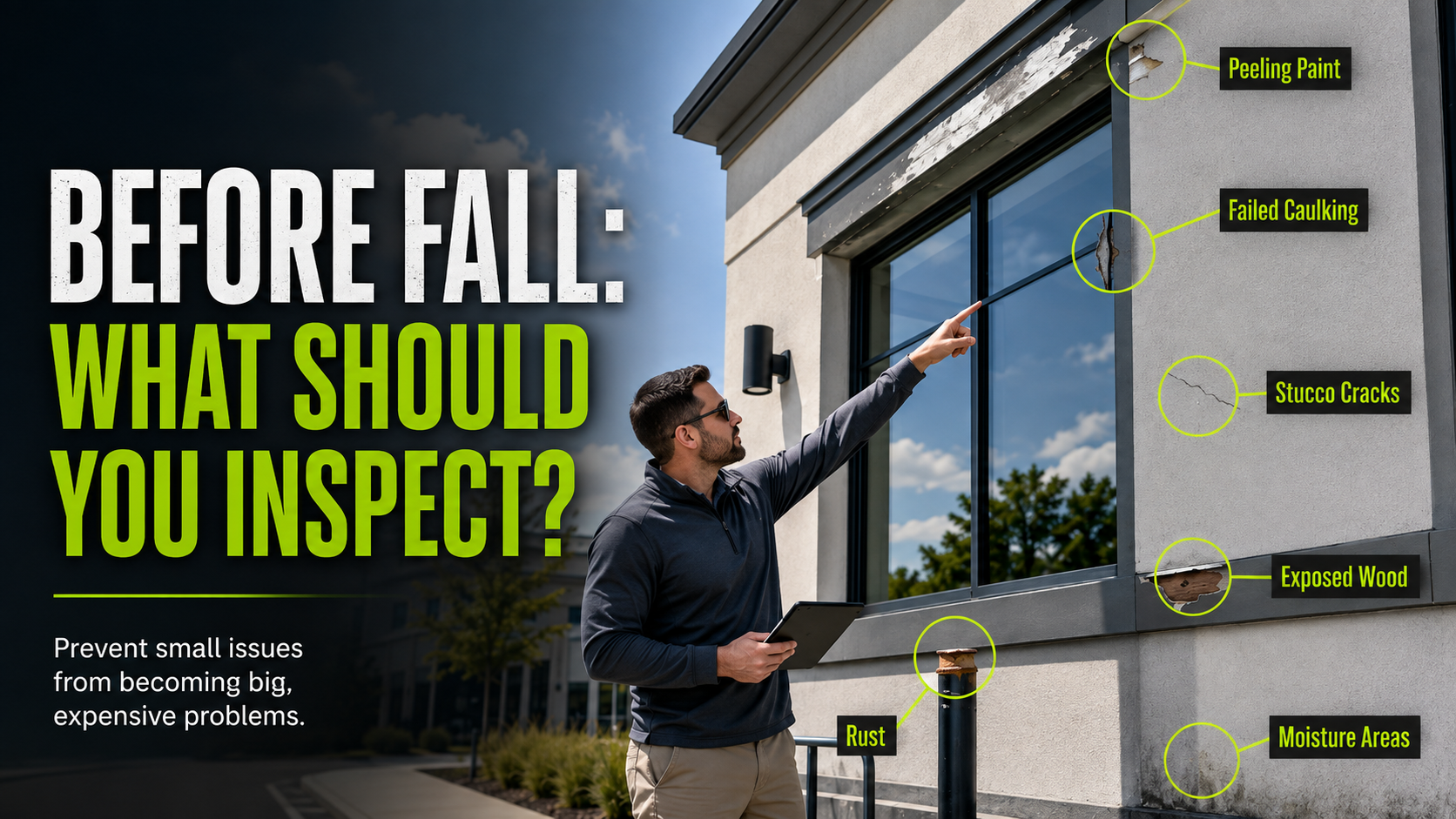
A contractor should inspect the stucco for cracking, chalking, loose or deteriorated areas, staining, moisture intrusion, previous patches, and failing coatings.
Cracks should also be evaluated rather than simply painted over. Some are minor surface cracks, while others may indicate movement or a repair issue that should be addressed separately.
New stucco also needs sufficient curing before coating. Manufacturer surface-preparation guidance notes that stucco should be clean, free of loose material, adequately cured, and within an appropriate surface pH range before painting.
Preparation
Depending on the existing condition, preparation may involve cleaning, removing loose coatings, repairing damaged stucco, sealing cracks where appropriate, addressing failed caulking, and priming repaired or porous areas.
The goal is to create a clean, sound, stable surface before the finish system begins.
Coating Options
High-quality acrylic masonry coatings are commonly used on commercial stucco because they provide exterior durability while allowing an appropriate level of vapor transmission.
For certain buildings, an elastomeric masonry coating may also be considered.
Elastomeric coatings are thicker and more flexible than conventional architectural paint and can help bridge minor surface imperfections while providing additional weather protection. Some commercial elastomeric systems are designed specifically for stucco, concrete, block, and other masonry surfaces.
However, elastomeric does not automatically mean “better.”
The building's moisture conditions, existing coating, wall assembly, crack conditions, and manufacturer's requirements should all be considered before specifying it.
Wood: Controlling Moisture and Protecting a Moving Substrate
Wood presents a very different challenge.
Unlike masonry, wood naturally expands and contracts as environmental conditions change. Moisture can also enter the wood through failed paint, joints, end grain, damaged caulking, or surrounding building components.
If the moisture problem is not corrected, simply repainting the surface may not solve the underlying issue.
Manufacturer guidance identifies moisture as a common contributor to exterior coating adhesion failure and recommends addressing the source before recoating.
What Should Be Evaluated?
Before painting exterior wood, a contractor should look for peeling coatings, exposed wood, dry or damaged areas, failed caulking, deteriorated trim, open joints, staining, mildew, and moisture-related problems.
Areas of rot or significant deterioration may need repair or replacement rather than paint.
Preparation
Loose and failing coatings should be removed to a sound edge.
Bare wood may need sanding and spot priming. Gaps, joints, and penetrations should be evaluated for caulking or repair.
The surface also needs to be clean and dry before the new coating system is applied.
Sherwin-Williams' exterior wood preparation guidance, for example, calls for clean, dry wood and recommends treating knots and pitch streaks before applying a full primer coat.
Primer Selection Matters
Certain wood species can release tannins that discolor the finish coating.
In those situations, the primer needs to do more than improve adhesion—it may need to block staining.
Exterior wood primers specifically designed for tannin and stain blocking are available for this reason.
After preparation and priming, a high-quality exterior acrylic finish or an appropriate exterior stain system may be specified depending on the type of wood and desired appearance.
The important point is that the contractor should understand what kind of wood is being coated and what caused the previous coating to fail before recommending the next system.
Metal: Surface Preparation Is Your Corrosion Defense
Exterior metal requires another completely different approach.
Railings, structural steel, stairs, gates, doors, bollards, equipment screens, and miscellaneous metal components are all common on commercial properties.
The primary concern is often corrosion.
Painting directly over active rust may improve appearance temporarily, but it does not provide the same protection as a properly prepared and specified coating system.
Protective-coating industry guidance identifies surface preparation and environmental exposure as major factors in selecting systems for structural steel.
What Should Be Evaluated?
The contractor should determine the type of metal, level of corrosion, condition of the existing coating, adhesion, environmental exposure, and whether any areas have experienced repeated coating failure.
Metal near irrigation, landscaping, coastal air, industrial conditions, or frequent moisture exposure may require a different specification than protected architectural metal.
Preparation
Preparation may range from cleaning and sanding to mechanical removal of loose rust and coating.
More demanding environments or protective coating specifications may require more extensive surface preparation.
The key is to remove contaminants, loose corrosion, and poorly adhered coating and create the surface condition required by the primer and finish system.
Primer and Finish System
Exposed steel commonly requires a corrosion-resistant primer before the finish coating.
Depending on the substrate and environment, the system might involve a dedicated metal primer followed by a compatible topcoat or a properly specified direct-to-metal system.
The appropriate coating depends heavily on exposure.
A decorative handrail under an overhang does not necessarily require the same coating system as exposed structural steel experiencing continuous weather.
That distinction is exactly why specification matters.
Concrete: Evaluate Moisture, Surface Profile, and Previous Coatings
Concrete is durable, but that does not mean every coating will adhere successfully to it.
Concrete can contain moisture, surface contaminants, curing compounds, laitance, cracks, previous coatings, and repairs that affect coating performance.
The condition and profile of the surface are especially important when protective coatings are being considered.
AMPP's current concrete surface-preparation standard specifically addresses cleanliness, strength, profile, contaminants, pH, moisture, and other substrate conditions that can influence coating performance.
What Should Be Evaluated?
A contractor should inspect concrete for cracks, spalling, efflorescence, moisture, previous coatings, contamination, failed repairs, exposed aggregate, and general surface soundness.
The evaluation should also consider how the concrete is used.
A vertical exterior wall has different performance requirements than a loading area, walkway, parking structure, or industrial surface.
Preparation
Depending on the system, concrete preparation may include cleaning, removal of loose material, crack and spall repairs, removal of incompatible coatings, and mechanical preparation.
Protective systems may also require a specified surface profile so the coating can achieve the intended bond.
Industry guidance stresses that concrete should be sound and properly prepared before bonded coatings or linings are installed.
Coating Selection
For exterior architectural concrete, a masonry coating may provide the appropriate combination of appearance and weather protection.
Some projects may call for elastomeric coatings, sealers, or other protective systems depending on moisture exposure and performance requirements.
Higher-demand concrete environments may require more specialized coating systems.
Again, the best option depends on the substrate and its service conditions—not simply the name on the paint can.
One Building May Require Several Coating Systems
This is where commercial exterior painting becomes more complex than residential repainting.
One commercial property may contain:
Stucco walls.
Wood fascia.
Steel railings.
Concrete columns.
Metal doors.
CMU walls.
Wood trim.
Previously coated architectural features.
Although all of these surfaces may ultimately be painted the same color family, they should not automatically receive the same primer and coating system.
A professional specification might use several systems across a single property while still creating one consistent finished appearance.
That is a sign of proper planning—not unnecessary complexity.
What Property Managers Should Ask Before Approving a Proposal
When reviewing an exterior painting proposal, don't only ask what paint manufacturer or product line will be used.
Ask how the contractor arrived at that specification.
A qualified commercial painting contractor should be able to explain what substrates are present, what preparation each surface requires, where primers will be used, what repairs are included, how existing coatings were evaluated, and why the recommended finish system is appropriate for the building's conditions.
It is also helpful to clarify whether the proposal identifies different coating systems for different substrates.
If a building contains stucco, wood, metal, and concrete but the proposal treats every surface exactly the same, that is worth discussing before work begins.
The Best Exterior Coating Starts With a Better Evaluation
There is no universal “best exterior paint” for a commercial building.
There is a best-fit coating system for a specific substrate, condition, environment, and maintenance objective.
For stucco, that may mean addressing cracks and porosity before applying a masonry system.
For wood, it may mean correcting moisture problems, preparing bare areas, and selecting the right primer.
For metal, corrosion control and proper surface preparation become critical.
For concrete, moisture, surface soundness, repairs, and profile may determine whether a coating system performs as intended.
The quality of an exterior painting project therefore begins well before the first finish coat is applied.
It begins with the inspection.
Planning an Exterior Painting Project?
Commercial Painting Inc. works with property managers, facility managers, and commercial property owners throughout San Jose, Silicon Valley, and the Bay Area to evaluate existing exterior surfaces and develop coating systems appropriate for each property's conditions.
If your building includes stucco, wood, metal, concrete, or a combination of substrates, our team can assess the property, identify preparation needs, and provide a detailed exterior painting proposal.
Schedule an exterior site evaluation with Commercial Painting Inc.
Contact Us
We will get back to you as soon as possible.
Please try again later.